

A practical system for agents, brokers, and real estate marketers who are tired of publishing content that reads like a robot wrote it.

You’ve seen it. Maybe you’ve published it.
“Nestled in this charming neighborhood, this stunning property boasts hardwood floors and an open-concept layout perfect for entertaining.” Twenty-two words. Zero of them yours.
It’s the blog post that technically ticks all the necessary boxes: the neighborhood stats, the market trends, and the buyer tips. But reads like it was written by someone who has never actually stood inside a house. Intros start with phrases like “In today’s competitive real estate market” or “picture this.” Paragraphs read like they were assembled from a checklist rather than written by a person who cares about actual quality of life.
Look, the reality is AI adoption is pervasive and scaling. In writing this article, I admit to AI use for outlining, breaking through that first paragraph’s writer’s block, and to suggest revisions.
But relationships in real estate depend on the human connection. That’s why your real estate blog posts and articles need to at least sound like you could have written it.
When AI is spitting out the generic “it’s not you, it’s them” sentence structures and bland voice, that’s a problem in how you’re using AI.
“Most people treat AI like a vending machine.”
Four Signals of AI Written Content
Before fixing anything, it helps to see the pattern clearly. Remember, language models are built on predicting what words or turns of phrase logically come next. These vary slightly by model because of the data they’re fed during training, but given that their diets are similar in content, certain trends have emerged.
Most of the current AI-generated real estate content fails in the same four ways:
Overused phrases
“Nestled in a charming neighborhood.” “This stunning property boasts.” “Perfect for families and entertaining.” If you’ve read one AI real estate post, you’ve read them all because everyone is pulling from the same default outputs.
Repetitive structure
Intro → three H2s → conclusion. Every time. The reader doesn’t know why, but something feels off. It’s because the content is a template in disguise. Its article structure feels exactly like what you learned in middle school English: a clear thesis, a “here’s why” statement to transition the introduction, followed by paragraphs stating a main idea and three proofs, and “wrapping up” in a summary. The conclusion header may even say “conclusion” or “wrapping up!”
Weak intros
AI defaults to context-setting. Humans want to start in the middle of something. There’s a difference between “The real estate market has seen significant changes…” and “Your buyers are scared right now. Here’s what to say.”
Technically correct, emotionally flat
This is the hardest one to name, but the easiest to feel. All the statements are accurate and truthful. But it lacks a solid point-of-view and voice. Great, this community is adjacent to the beach. What does that feel like as a human being?
The Two Steps Most People Skip With AI
Most people treat AI like a vending machine. They type a topic, hit enter, copy the output, and post it. It’s why flat content is on every corner of the Internet.
The approach that actually works is a two-step system:
- Better input (the prompt). What you put in determines the standard of what comes out.
- Smarter editing (the revision pass). This is where most people stop, and where most of the human voice gets added back in.
Neither step is complicated, and maybe adds about ten extra minutes to your content creation. Is it worth it? If you care about the difference in output quality, absolutely!
The Prompt I Use for Real Estate Blog Posts
Here’s a trimmed version of the core prompt structure that consistently produces cleaner first drafts:
Write a blog post for [target audience] about [specific topic]. Use a conversational but authoritative tone — like a knowledgeable agent talking to a client, not a press release. Start with a specific scenario or problem the reader is already experiencing. Avoid filler phrases like ‘in today’s market’ or ‘it’s important to note.’ Keep sentences short. Write in second person.
Why does this work? Three reasons:
First, it specifies who is speaking (an agent, not a content mill). Second, it gives the model a structural anchor. “Start with a problem” breaks the default intro pattern. Third, it explicitly rules out the clichés, so the model has to find another way to structure the ideas and phrases.
You’ll still need to edit. I’ve told outputs to drop, “it’s not only,” from drafts. They sneak it back in. Still, you’re starting from a much better place with fewer cuts and changes to make.
How to Make AI Sound Human (Fast)
Once you have a draft, run it through two or three targeted revision prompts before touching it yourself.
Revision Prompt 1 — Voice check:
Read this draft and identify any sentences that sound like AI content. Rewrite them in a more conversational, direct voice. Flag any clichés.
Revision Prompt 2 — Intro punch-up:
Rewrite the opening paragraph so it starts in the middle of a specific moment or problem. No scene-setting. No statistics in the first sentence.
Revision Prompt 3 — Cut the filler:
Remove any transitional filler (“additionally,” “furthermore,” “it’s worth noting”) and replace with shorter, more direct connectors or no connector at all.
Take this example of a quick before-and-after on the intro alone:
Before (raw AI output)
“In the current real estate landscape, buyers are facing a number of challenges that can make the homebuying process feel overwhelming.”
After (revision prompt applied)
“Your buyers are nervous. The headlines warn about the interest rates, low inventory, and bidding wars. What they haven’t heard is a clear plan.”
Revision turns that hook into a completely different read.
A Quick Example Workflow
Here’s what this looks like start to finish for a single blog post:
Topic: What first-time buyers need to know about making offers in a low-inventory market
Step 1 — Prompt
Asks for an output. This example uses the sample prompt above, tailored to first-time buyers and the specific market condition.
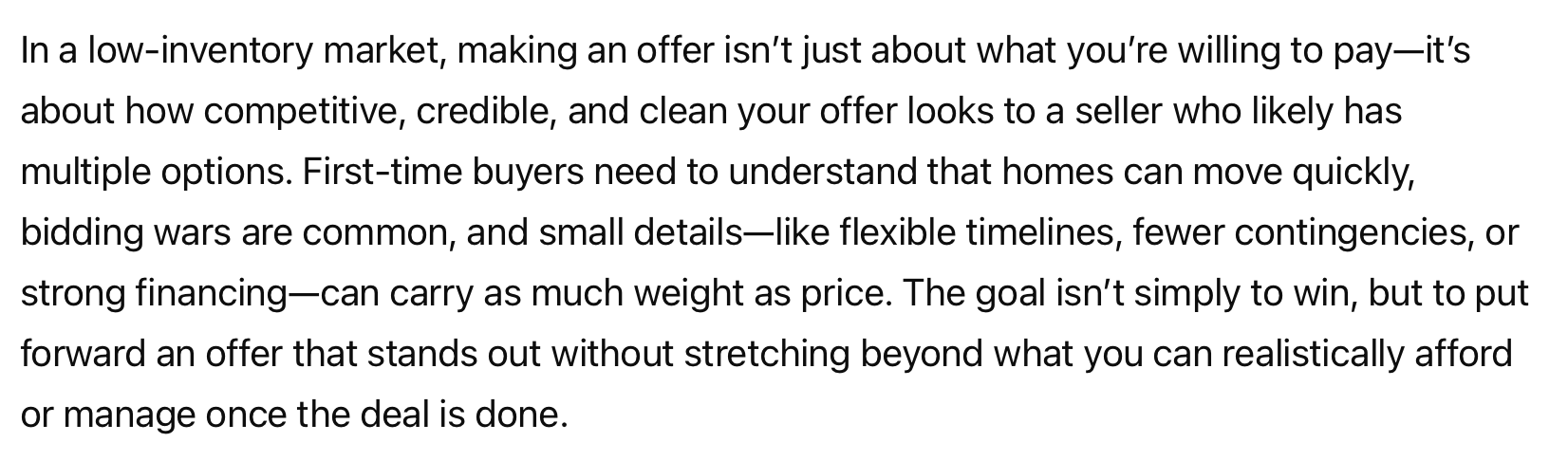
Step 2 — Rough draft
Copy the output into a working doc. Read it all the way through before editing.
Step 3 — Revision prompts
Run the voice check, intro punch-up, and filler cut in sequence. Each takes about 60 seconds.

Step 4 — Your edit pass
Now read it like a human. Add one or two sentences that only you could write. Think of a specific example, a client anecdote, or a local detail. This is what makes it yours.
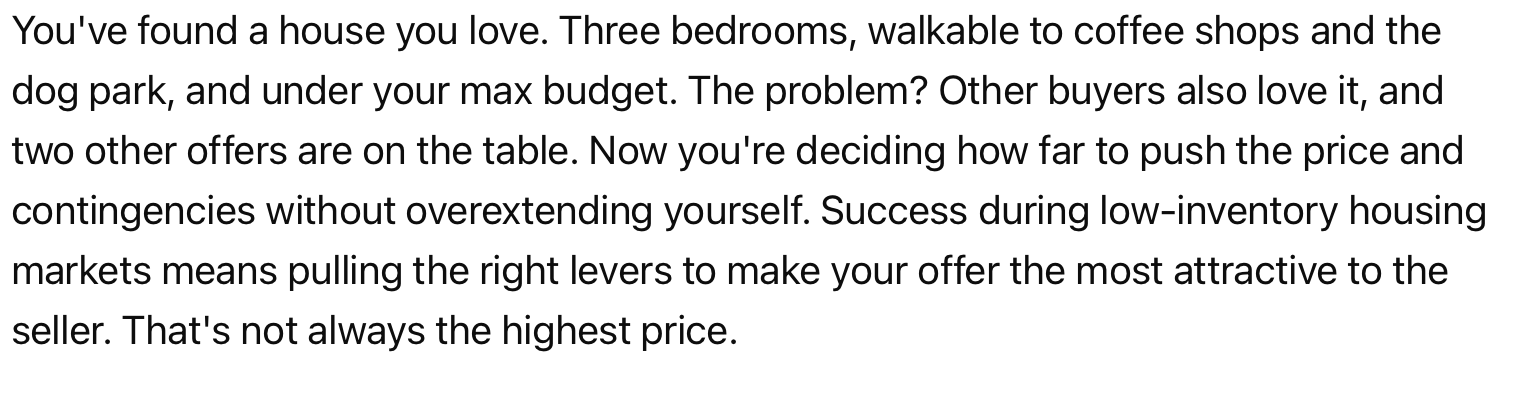
Step 5 — Publish
Total time, once you’ve done the process a few times, you’ll find it takes 20–30 minutes for a complete blog post. Compare that to staring at a blank doc for an hour.
If You Want the More Prompts…
This workflow is a solid starting point, but there’s a lot more underneath it. You’ll want prompt variations for different post types, a checklist for the revision pass, and the exact phrases to cut from every AI draft before it goes live based on today’s outputs.
I put it all into a free, three-page guide you can use right away. No fluff, no upsell, just a few prompts to get your real estate content working.
Try it out and let me know how it works for you→ Download the free Real Estate AI Writing Kit.
Leave a Reply