
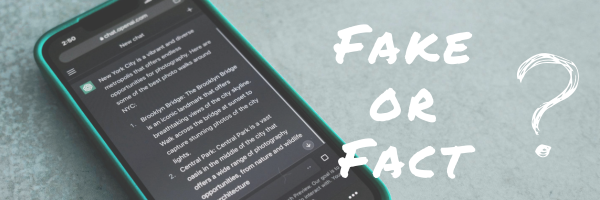
The article confidently listed the top employers for Fort Mill, South Carolina: “LPL Financial, Ross Stores, and Bank of America.” But, as I tell my kid all the time, speaking something with confidence doesn’t make it true.
AI-generated copy has the same problem: it can hallucinate or misrepresent facts, as it did here. Since I edit AI-created content regularly, I know to check its factuality. A quick search proved the three businesses above do not rank among Fort Mill’s top employers by size.
Publishing wrong information is one of the fastest ways to tank your brand reputation.
Always Assume AI Is Wrong
Treat AI like it’s guilty until proven innocent. ChatGPT can hallucinate facts. So do Claude, Perplexity, and Google. No model has proven itself to be 100% reliable on factual claims. One 2024 study found ChatGPT-4 had a 28.6% hallucination rate.
Factual claims are any information or statements based on objective reality and verified facts–no emotion or personal bias.
Bias: Traffic is always terrible in Charlotte.
Factual: Charlotte drivers spend 64 hours each year stuck in traffic. Proof: 2025 Urban Mobility Report
If you publish it, it must be accurate. The responsibility lies with the humans, not the model. People must be involved in the copy and editing process.
I’ve developed this workflow to speed up fact-checking AI-generated content.
“Treat AI like it’s guilty until proven innocent.”
Process to Fact Check AI Sources
1. Start with the claims that are easy to check
2. Check anything time-sensitive
3. Dig deeper on claims that aren’t data points
4. Ask the AI where it got the claim
Data and Sources First
Just like taking a multiple-choice test in school, I knock out the easiest first. These are the numbers, named sources, and cited links. For instance:
“According to NAR’s 2024 Profile of Home Buyers & Sellers, professionally photographed homes spent an average of 16 fewer days on the market.”
In this claim, I verify the number (16 days) and the named source (NAR 2024 Profile of Home Buyers & Sellers).
A specific source like Zillow or the US Census Bureau should be easily searchable to find their public information. In Google search, I:
| Paste the source | NAR’s 2024 Profile of Home Buyers & Sellers |
| Paste the actual claim | photographed homes spent an average of 16 fewer days on the market |
| Add “fact check: [paste claim]” | “fact check: photographed homes spent an average of 16 fewer days on the market” |
Adding “fact check” to the search is great for lesser-known sources, or if multiple webpages are citing a statistic without linking to a reliable primary document or report.
Be careful relying on AI overviews–more on that a little later.

Red Flag Recent Time Claims
All large language models and AI systems train on data, but that data has a cut-off date. Recent events are a known blind spot in AI-generated copy.
Copy that says “May 2026” when it’s currently July 2026 is an immediate signal to double-check the claim. It’s simply too recent to be accurate.
Another tell is the words used in statements. Keep a lookout for:
- Current/Currently
- As of now
- Recent/Recently
- Last month
Review Verifiable Statements
Listing top employers in a city isn’t a statistic or a time-based claim, but it’s still a factual claim that needs checking. Some examples of inaccurate statements I’ve encountered when checking AI-generated content:
- A park described as being in a neighborhood when it’s an hour away
- A concert venue that’s since closed
- A school offering a magnet program it doesn’t have
- The wrong attribution for a popular quote
Fact-checking these claims takes slightly more time. Commonly, I run a Google search. For location-based claims, like Latta Park being in Fort Mill, a Google Maps search shows it’s nowhere near the city. The statement about the magnet program required checking the school website and the school district.
Make AI Do the Work
If you had ChatGPT or Claude generate the content, make it do some of the heavy lifting.
The easiest approach is to ask the model to include its sources when you write the prompt. Then you’ll go to the cited source and verify the AI pulled the information correctly.
Otherwise, take the suspicious statement and ask the AI to find the source or to fact-check itself.

Sometimes you’ll get the telling walk-back reply: “I can’t find a source.” Once I even received a “Whoops! I made that up!”
The ideal answer is a link to a cited source that you visit for verification. If not a direct link, then at least a report or an institution to track down.
When using a generative search engine, I find Gemini surfaces sources more readily than Claude. Checking Claude’s claims takes more time, but the output style of its models may be worth the trade-off.
What Qualifies As A Good Source
Google search presents AI Overviews when you search for a topic.
That AI Overview is not a reliable source for verifying a factual claim!
Think of it this way: a student takes notes from a teacher’s PowerPoint lecture. They write a summary of their notes and share it online.
Can you trust that their summary reflects the key idea, or that the student took accurate notes?
Fact-checking is only viable if you have an authoritative, trustworthy source.
- First-hand accounts (including your personal anecdotes)
- Studies that publish their methodology
- Government reports
- Peer-reviewed journals and studies
- Databases or data hubs
- Organizations that publish quality or ethical standards
Good primary sources?
US Census Bureau, your local real estate board, Department of Housing and Urban Development: yes.
Norada, Movoto: likely not
Add Factuality When Checking AI-Generated Content
Always review AI-generated content before hitting “publish.” No matter how many example files of your voice or reference files are uploaded, it’s your reputation on the line, not Perplexity’s or Gemini’s. An inaccurate claim does lasting damage.
Leave a Reply