

Writing for people and writing for AI to quote are two distinct skills. The latter involves generative engine optimization (GEO), a discipline closer to journalism than traditional content marketing.
Why journalism? Reporters train for exact constraints Large Language Models (LLMs) operate under:
- Be factual
- Say the most important idea first
- Write in a way that survives being pulled out of context
- No fluff
These principles rule writing when content is trimmed to a headline, a pull quote, or a wire snippet. It’s also, as it happens, the task if you want ChatGPT or Perplexity or Google’s AI Overview to lift a sentence from your page and cite you as the source.
Learn the sentence-level mechanics and structural habits that make a page quotable to a machine that analyzes it to extract information.
What “quotable by AI” means
An answer engine scans website text for a self-contained answer with authority signals that it can lift and attribute back to you. For GEO, being quotable requires:
Structural extractability
A paragraph answers one question completely without reliance on other sections for context. Not a paragraph part of a larger section building toward a payoff sentences or paragraphs later. One unit, one answer, done.
Verified authority
“Quotable” also means your information answers a viable question someone is searching for. But AI doesn’t want your grandmother’s poultice recipe. Programmers want AI to be useful, and that means sourcing their information from trustworthy sources.
Which brings us to the second test: does this information come from a real person with real experience? It’s the “authority” piece in Google’s E-E-A-T framework.
| Pillar | Description |
|---|---|
| Experience | Real, hands-on life experience in the topic |
| Expertise | Strong knowledge, related certifications, or skills in the field |
| Authority | Others in the field acknowledge their expertise |
| Trustworthy | Accurate, honest, and transparent |
Answer engines are getting better at spotting the difference between someone who did the thing and someone who summarized what other people said about the thing.
In short, for AI to quote you, it needs to be:
- Structurally easy to find and pull
- Specific, trusted real-world information
Structuring content to be quotable in AI Search
Organization is a large part of how to write for AI search engines.
Lead with the answer
Traditional long-form content marketing builds toward a revelation. AI skips the conversation entirely and wants answers upfront.
Enter the inverted pyramid, a structure journalists learn early in their careers. The inverted pyramid leads with the most critical, factual information, followed by supporting details, more context, and so on.
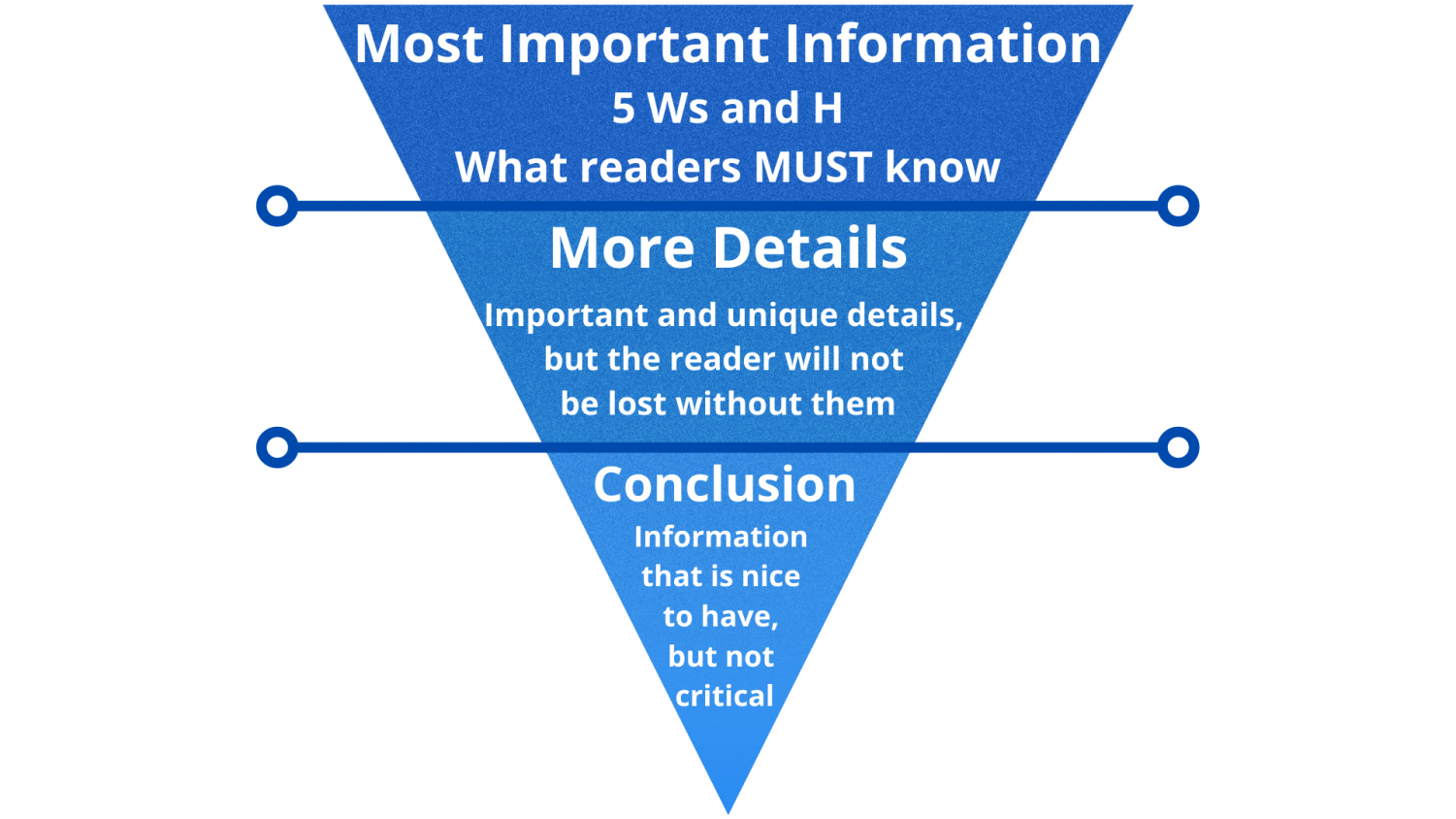
The idea is you can cut length from the bottom up without losing any significant meaning. A reader “gets the gist” even if they don’t read past the first paragraph. And if they do, what they’re reading adds color to their understanding.
AI search engines reward answering first, then adding context and nuance.
In practice:
- Buried lede version: “There’s a lot of debate about how often you should really be posting on LinkedIn, and the answer depends on your goals, your industry, and how much time you have. Some experts say daily. Others say quality over frequency matters more.”
- Answer-first version: “Post on LinkedIn three to five times a week. That’s the range where the platform’s algorithm keeps rewarding you without your audience tuning out. After that, the engagement per post drops.”
The second one gives the AI engine a definitive, citable fact up front. The first one is traditional marketing throat-clearing.
Write standalone paragraphs
Each paragraph should keep its meaning if it was cut out of the page and dropped somewhere else. No “as mentioned above.” No sentence that depends on the one before for comprehension. If a paragraph needs its neighbors, an extraction engine will either mangle it or skip it for a competitor’s cleaner one.
Standalone paragraphs matter for human readers, too. SEO writers long catered to skimmers and people arriving mid-article from a search result with short paragraphs and clear headers. People prefer snippets and speed. Short, clear paragraphs are non-negotiable now.
Plain sentences win
Declarative thoughts. One idea per sentence. However, vary your rhythm so it doesn’t read as if a machine wrote it. People naturally write with a mix of short, medium, and long sentences. But even long sentences benefit from declarative statements that keep the idea clear enough for people and AI bots.
Building authority for GEO
Answer engines increasingly reward real examples and observations that nobody could have pieced together from a training set of documents.
Put yourself into the copy
How many LinkedIn posts have you read that opened with “In today’s fast-paced business environment…?”
Do you talk like that? Most people don’t.
Write like you. Voice distinguishes a person, and for that, it’s the small details.
For example, I once wrote podcast summaries and social media copy for a business coach who was an avid surfer. Unfortunately, I became too busy to keep her, but she reached out months later to see if I was free. She still hadn’t found someone who captured her voice the way I did.
What made the difference? Anyone can do a podcast summary, but her love of surfing made her special. She catered to active people just like her, with a work-hard, play-hard mindset and a love of catching barrels and waiting for sets.
Adding the lingo and the voice helped her podcast stand out among other coaches.
Be hyper-specific with details
AI can’t replicate your specific and personal observations. Answer engines increasingly reward real examples and observations that nobody could have pieced together from a training set of documents.
My favorite generic phrase of the moment: “tree-lined streets.”
A tree-lined street in Los Angeles is a lot different than the towering live oaks I grew up with. It’s a completely different image, and that’s the level of specificity to bring to your writing.

Generic advice is easy to write. It’s how copy gets dinged for being “AI-generated.” An engine can generate a thousand versions of that sentence without ever having run a business.
What an LLM can’t accurately recreate is the number, the name, the wrong turn, or the one line a client said in a meeting. Those special observations humanize your writing.
The GEO Formatting Checklist
- Lead with the answer in the first sentence of every major section.
- One question per section, phrased the way people ask it.
- Paragraphs stand alone without external context.
- Declarative sentences with varied lengths and rhythm.
- Include one detail only a human could have written.
How to write for AI Search
None of this is a trick for gaming a new kind of search. It’s applying the discipline of the craft that’s existed for years in journalism, repackaged for how we read today. Precise structure, authentic details, and expertise have always separated writing that gets used from writing that gets scrolled past.
Leave a Reply