
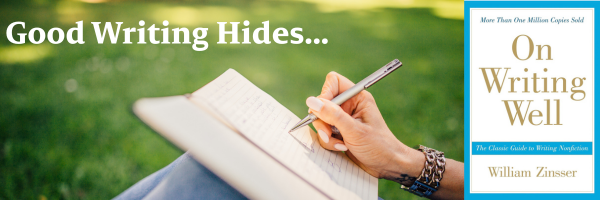
Hiding is the true craft of writing.
Why would hiding be the point of a craft? Because when writing is good, it becomes invisible. Instead, you leave with what you came for: new knowledge, emotional resonance, or entertainment. It sits with you long after the last word.
Put another way: do you look at a house and say, “Wow, that framing is spectacular. What a solid slab foundation!”
No. You see a finished, dressed home. The structure hides.
That’s the premise of On Writing Well, William Zinsser’s classic on nonfiction writing. Fifty years on, the book’s advice holds up–maybe even more in an age where every word choice is questioned as “AI or not?”
On Writing Well changed my writing more than any course, craft article, or workshop I’ve taken in years. Anyone who puts words into the world will find valuable lessons in its pages.
Zinsser built the book from the nonfiction writing course he taught at Yale, but its lessons cross genres. His advice sharpened the fiction manuscript I just finished, reshaped the hooks of my travel articles, and added clarity to SEO content I write for clients.
A few of Zinsser’s ideas influenced my recent work.
Nobody told all the new computer writers that the essence of writing is rewriting. Just because they’re writing fluently doesn’t mean they’re writing well. – William Zinsser
Writing is a craft
Let’s begin with the elephant: AI-generated copy. Why pay a writer when you can have a machine churn out something of acceptable quality?
Because writing is more than predicting the next logical word choice or pattern.
For years, teachers and people in my circle touted my “writerly qualities” and “natural talent.” Then a big fat “F,” in my first English 101 essay burst that idea.
The instructor refused to accept “good enough” as “good at all.” For the first time, someone held writing to a clear standard and explained why. He tore apart the popular five-paragraph structure as a crutch for weak arguments and pushed us to support ideas on their merits. He judged them as weak or strong based on our clarity.
He sliced through the language with a knife and demanded we justify every word choice pulled from the thesaurus. Sentences went under the same scrutiny. Why did we use this clause in this place? Why this word to start this paragraph?
The message? Be precise. Value your words.
Reading Zinsser’s writing tossed me decades back to that classroom, striking through sentences I’d labored over for hours.
The mercilessness made me better.
“The secret of good writing is to strip every sentence to its cleanest components.” –William Zinsser
Good writing takes more than innate talent. Thinking clearly and finding the right order for the right words is a skill built through practice.
Fewer people would be debating generative copy’s merits– and we’d need fewer editing rounds– if AI wrote well.
The greatest gift readers give us is their time. As writers, we owe them writing that’s clear and succinct.
Part of this essay’s first draft, marked up.
Writing is not meant to be easy
Zinsser insists writing is a process, not a burst of inspiration. Nothing arrives finished. His own edited pages, reproduced in the book, prove it.
The struggle is normal. Stephen King popularized “kill your darlings,” but he echoed an earlier British writer, Sir Arthur Quiller-Couch, who lectured on writing in the 1910s.
Zinsser shared marked-up manuscript pages to his third edition to show that every sentence has room for improvement.
“Writing is hard work. A clear sentence is no accident. Very few sentences come out right the first time, or even the third time.” –William Zinsser
People have revered writers for eons. We speak of their skill and wit with admiration. Anyone who has ever tried to put something coherent on the page knows it’s not easy. If it were, professional writers would have no place.
Nor would we be constantly training and tweaking and reworking the combinations AI assembles. It may be fast, but it likes to put things on the page that shouldn’t be there.
As Zinsser says, “effortless style is achieved by strenuous effort.”
Clutter is the enemy
Zinsser’s earliest chapters home in on clutter. It’s everywhere–on my kitchen counter and in useless words packed into my sentences.
“Good writing is lean and confident,” Zinsser writes. Pruning words forces precision. Away with redundant adverbs, one cardinal sin of AI copy. “Genuinely,” “quietly,” and “actually,” float about our feeds and blogs like one-hit songs that won’t die. I cringe every time I see them.
“Again and again in careless writing, strong verbs are weakened by redundant adverbs.” –William Zinsser
Qualifiers and dead words tacked onto verbs like “up” and “out” clutter our writing. We add clauses and asides, hoping for clarity and getting the opposite. We slow the pace and bury the point.
To sound intelligent, we reach for words with more syllables: “numerous” for “many” and “implement” for “do.” Jargon like “enterprise” and “thought leadership” enters the conversation. What happened to the humble “in my opinion?”
Focus on the start
Content and copywriters know the first sentence carries any article. No hook, and the reader’s off to the next page.
Strong hooks are an old premise, writers know. Zinsser says, “The most important sentence in any article is the first one,” but also, “ give as much thought to your last sentence as your first.”
I commonly accept that my first paragraph is destined for the trash. In college, I frequently took my first draft’s conclusion and made it the introduction in draft two. It usually stated the thesis more clearly and with a better lead than the original.
Starts are hard, Zinsser agrees. Finding that perfect balance of intrigue and information gets harder when attention spans are under 30 seconds.
Now I spend even more time on the introduction. For a recent travel article, I rewrote the opening 12 times, chasing the balance between clarity, hook, keywords, and word count.
Personality is what’s left
When you say you like a writer, Zinsser argues, what you really like is their personality.
Today, it’s the last defense of the craft.
Technique gives your ideas clarity, but personality is what keeps a reader.
One of my favorite examples is Zero: The Biography of a Dangerous Idea. It’s about the history of the number “zero,” a subject as dry as any algebra teacher. But Charles Seife’s voice carries you along until you’re enamored with how humankind accepted the idea of nothing as a number.
A taste:
“Zero and infinity are eternally locked in a struggle to engulf all the numbers. Like a Manichaean nightmare, the two sit on opposite poles of the number sphere, sucking numbers in like tiny black holes. Take any number on the plane. For the sake of argument, we’ll choose i/2. Square it. Cube it. Raise it to the fourth power. The fifth. The sixth. The seventh. Keep multiplying. It slowly spirals toward zero like water down a drain. What happens to 2i? The exact opposite. Square it. Cube it. Raise it to the fourth power. It spirals outward. But on the number sphere, the two curves are duplicates of each other; they are mirror images.” ― Charles Seife, Zero: The Biography of a Dangerous Idea
Sure, AI can produce clean and grammatically competent sentences in half the time any fast writer can. The mechanics are cheap and automated.
What AI can’t do is have a lived and original point of view. As Zinsser puts it: “Who he or she is.” A voice.
We must rely on our experience to find our personality. Everyone has a unique way of connecting ideas. Their rhythms and catchphrases, their anecdotes and word choices.
Zinsser must have had a crystal ball when we said, “we may be given new technologies…but we’re all working with the same words and the same principles.” Did he know in 2006 that ChatGPT was coming?
Real writers take the same topic we’re all writing about and find their originality inside of it.
Find what makes you special
In the weeks since finishing On Writing Well, I:
- Added a revision step that turned into full rewrites from draft zero to draft one.
- Became more aware of adjectives.
- Leaned into clarity, trying to use simple words whenever possible.
Anyone can use AI to generate a clean paragraph in seconds. The hidden labor is no longer in grammar and word choices. It’s the years of thinking and caring about work that has a point of view. It’s about wanting to leave a person with something worth their time: information, a feeling, a sense of well spent time. You can’t fake that, and you can’t produce it with a machine.
“Writing well means believing in your writing and believing in yourself, taking risks, daring to be different, pushing yourself to excel.” –William Zinsser
Leave a Reply